
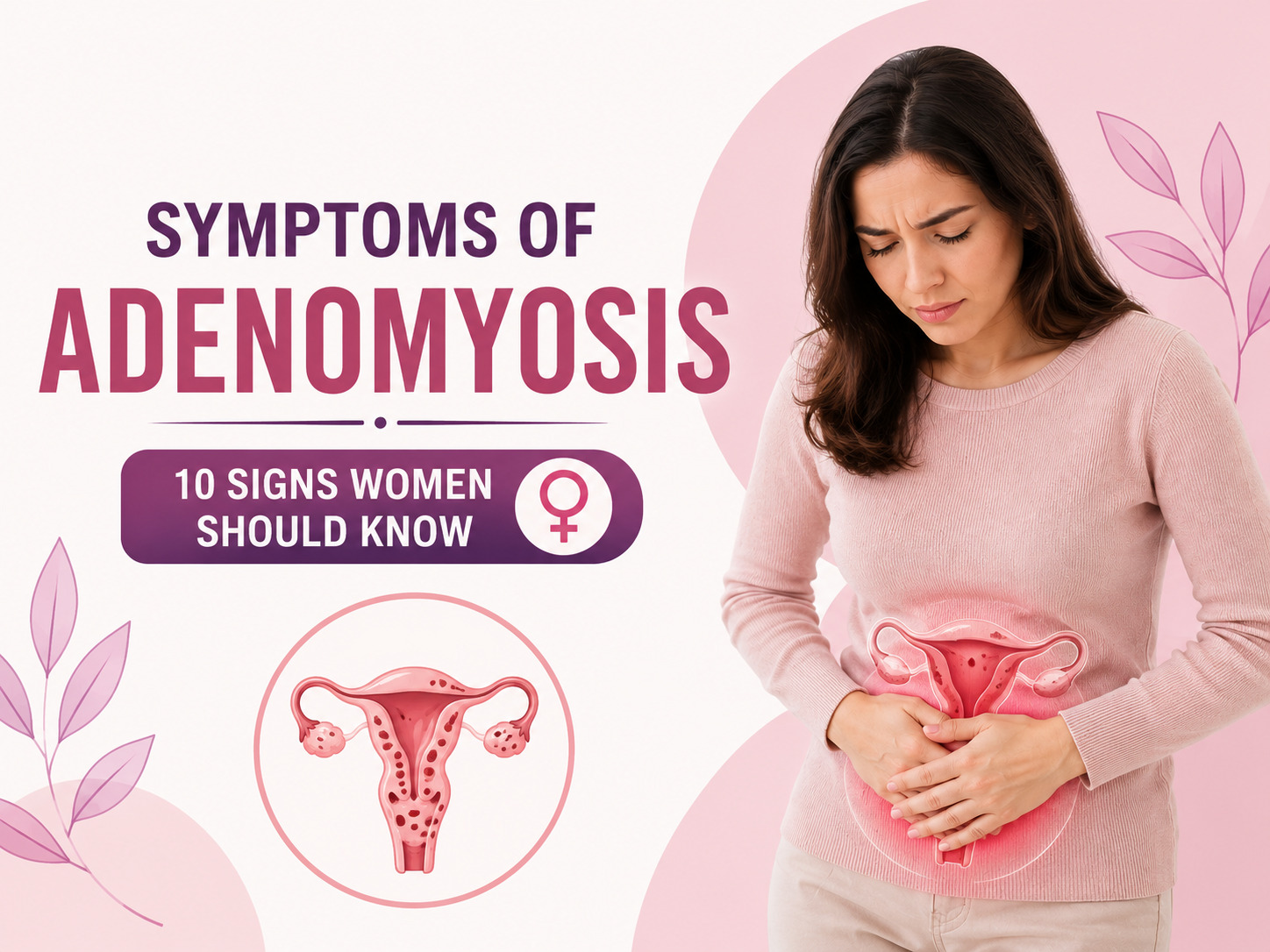
If you are wondering what are the symptoms of adenomyosis, the most common signs include very painful periods, heavy bleeding, pelvic pain, bloating, a feeling of heaviness in the lower tummy, and pain during sex. Some women have adenomyosis without having any symptoms at all.
Adenomyosis is a condition that affects the womb. It can be uncomfortable and may affect your daily life, especially when period pain or heavy bleeding becomes difficult to manage.
The good news is that treatment options are available. The right treatment depends on your symptoms, age, health, and whether you want to have children in the future.
What Is Adenomyosis?
What exactly is adenomyosis?
Adenomyosis happens when tissue similar to the lining of the womb grows into the muscle wall of the womb.
This can make the womb wall thicker.
It can also make periods more painful and heavier for some women.
Adenomyosis can happen at different ages, but it is more commonly diagnosed in women over 30.
Some women may have adenomyosis without knowing it because they have few or no symptoms.
What Are the Symptoms of Adenomyosis?
How do I know if I have adenomyosis?
Symptoms can be different from woman to woman.
The most common signs include:
- Very painful periods
- Heavy menstrual bleeding
- Pelvic pain
- Bloating
- A feeling of heaviness or fullness in the tummy
- Pain during sex
- Lower abdominal discomfort
- Periods that affect your daily activities
- Tiredness caused by heavy bleeding
- Changes in your usual menstrual pattern
These symptoms can also happen with other conditions, including fibroids and endometriosis.
That is why a proper medical assessment is important.
1. Very Painful Periods
Can adenomyosis cause painful periods?
Yes. Very painful periods are one of the main symptoms of adenomyosis.
The pain may feel like strong cramps or a deep ache in the lower abdomen.
For some women, the pain can be severe enough to affect normal activities.
You may find it difficult to:
- Go to work
- Exercise
- Sleep properly
- Travel
- Look after your family
- Concentrate during the day
If your period pain has become much worse than it used to be, it should not simply be considered a normal part of having periods.
2. Heavy Periods
Can adenomyosis cause heavy periods?
Yes.
Adenomyosis can cause periods that are much heavier than usual.
You may notice that you:
- Need to change period protection very often
- Bleed for many days
- Pass large blood clots
- Bleed through clothes or bedding
- Feel exhausted during your period
Heavy bleeding can affect your quality of life.
It can also lead to iron deficiency or anaemia over time.
If your periods are becoming heavier, speak with your GP or gynaecologist.
3. Pelvic Pain
Can adenomyosis cause pelvic pain?
Yes.
Adenomyosis can cause pain in the lower part of your abdomen or pelvis.
The pain may occur during your period, but some women can also have pelvic pain at other times of the month.
You may describe it as:
- A deep ache
- Pressure
- Cramping
- Heaviness
- A constant discomfort
- Pain that becomes worse during your period
Persistent pelvic pain should be assessed because there are many possible causes.
4. Bloating and a Heavy Feeling
Can adenomyosis cause bloating?
Yes.
Some women with adenomyosis experience bloating or a feeling of fullness in the lower abdomen.
You may feel as though your tummy is swollen or heavy.
This can be especially noticeable around your period.
However, bloating is common and can have many causes.
Digestive problems, hormonal changes, constipation and other gynaecological conditions can also cause bloating.
Can adenomyosis make your stomach look bigger?
It can sometimes make the lower abdomen feel fuller or heavier.
This may happen because adenomyosis can cause changes in the size and shape of the womb.
However, a bigger-looking stomach does not automatically mean you have adenomyosis.
A medical assessment is needed to find the cause.
5. Pain During Sex
Can adenomyosis cause pain during sex?
Yes.
Some women with adenomyosis experience pain or discomfort during sex.
The pain may feel deep inside the pelvis.
It may happen during sex or continue for some time afterwards.
Pain during sex can also have other causes, such as:
- Endometriosis
- Fibroids
- Vaginal dryness
- Pelvic infections
- Pelvic floor problems
If sex has become painful, it is worth discussing this with a healthcare professional.
You do not have to simply accept ongoing pain as normal.
6. Lower Abdominal or Back Pain
Can adenomyosis cause back pain?
Some women with adenomyosis experience pain that spreads into the lower back.
This may happen together with pelvic pain or painful periods.
You may notice that the pain becomes stronger around your period.
Back pain can have many causes, so it is important to look at your other symptoms as well.
If you have back pain along with very painful or heavy periods, mention both symptoms during your appointment.
7. Feeling Very Tired
Can adenomyosis make you tired?
Adenomyosis itself may not directly cause tiredness in every woman.
However, heavy menstrual bleeding can lead to iron deficiency and anaemia.
This may make you feel:
- Very tired
- Weak
- Dizzy
- Short of breath
- Less able to exercise
- Unable to concentrate
If you have heavy periods and feel tired most of the time, your doctor may recommend a blood test to check for anaemia.
8. Changes in Your Periods
Can adenomyosis make periods irregular?
Adenomyosis is mainly linked with painful and heavy periods.
Some women may also notice changes in their usual bleeding pattern.
However, irregular periods can have many other causes.
These can include:
- PCOS
- Hormonal changes
- Thyroid problems
- Stress
- Perimenopause
- Changes in contraception
- Pregnancy
If your menstrual pattern changes and stays different from normal, speak with your GP.
9. Difficulty Getting Pregnant
Can adenomyosis affect fertility?
The relationship between adenomyosis and fertility is still being studied.
Some women with adenomyosis become pregnant naturally without problems.
However, adenomyosis may be linked with fertility difficulties in some women, particularly those who are already having trouble becoming pregnant.
If you have adenomyosis and are trying to conceive, speak with your gynaecologist.
Your doctor can consider your symptoms, age, fertility history and pregnancy plans when discussing treatment.
Can I get pregnant if I have adenomyosis?
Yes.
Having adenomyosis does not mean you cannot become pregnant.
Many women with the condition do become pregnant.
If you are having difficulty conceiving, a fertility assessment can help identify whether adenomyosis or another condition may be contributing.
Is Adenomyosis the Same as Endometriosis?
What is the difference between adenomyosis and endometriosis?
They are different conditions, although their symptoms can look similar.
With adenomyosis, tissue similar to the womb lining grows into the muscle wall of the womb.
With endometriosis, tissue similar to the womb lining grows outside the womb, often around the pelvis.
Both conditions can cause:
- Painful periods
- Pelvic pain
- Pain during sex
- Heavy periods
- Fertility problems
Because the symptoms can overlap, a doctor may need to consider both conditions when investigating pelvic pain or severe period symptoms.
Is Adenomyosis Dangerous?
Should I be worried if I have adenomyosis?
Adenomyosis is a benign condition.
This means it is not considered a cancerous condition.
However, that does not mean you should ignore symptoms.
Severe pain and heavy bleeding can have a major effect on your quality of life.
Heavy bleeding can also lead to anaemia.
The aim of treatment is usually to reduce symptoms and help you get back to your normal activities.
Can Adenomyosis Go Away on Its Own?
Does adenomyosis disappear without treatment?
Adenomyosis does not usually simply disappear on its own during the reproductive years.
However, symptoms often improve after menopause because hormone levels change.
If you have no symptoms, you may not need treatment.
If you have pain or heavy bleeding, treatment can help manage the symptoms.
Can Adenomyosis Get Better After Menopause?
Does adenomyosis improve after menopause?
Adenomyosis symptoms often improve after menopause.
This is because the condition is affected by hormones and periods stop after menopause.
However, new bleeding or new pelvic symptoms after menopause should always be discussed with a doctor.
Do not assume that every new symptom is caused by adenomyosis.
How Is Adenomyosis Diagnosed?
How do doctors find adenomyosis?
Your doctor will first ask about your symptoms.
You may be asked:
- How painful are your periods?
- How heavy is your bleeding?
- How long do your periods last?
- Do you have pelvic pain?
- Do you have pain during sex?
- Have your periods changed?
- Are you trying to become pregnant?
Your doctor may also examine your abdomen and pelvic area.
Further tests may then be recommended.
Can an Ultrasound Detect Adenomyosis?
Is an ultrasound used to diagnose adenomyosis?
Yes.
An ultrasound is commonly used when adenomyosis is suspected.
A transvaginal ultrasound can give a detailed view of the womb and may show changes linked with adenomyosis.
An MRI scan may also be used when more detailed information is needed or when the diagnosis is unclear.
Your doctor will decide which test is appropriate based on your symptoms and examination.
When Should I See a Gynaecologist for Adenomyosis?
What symptoms should I get checked?
You should speak with your GP if:
- Your periods have become much more painful
- Your periods have become heavier
- Period pain is affecting your daily life
- You have ongoing pelvic pain
- You experience pain during sex
- You have persistent bloating or abdominal heaviness
- You have bleeding between periods
- You have bleeding after sex
- You have heavy bleeding for a long time
- You are struggling to become pregnant
A gynaecologist can investigate whether adenomyosis or another condition may be causing your symptoms.
How Is Adenomyosis Treated?
Can adenomyosis be treated?
Yes.
Treatment depends on your symptoms and your personal situation.
Your doctor may consider:
- Pain relief
- Medicines to reduce heavy bleeding
- Hormonal contraception
- A hormonal coil such as an IUS
- Other hormone-based treatments
- Non-surgical procedures
- Surgery in some cases
The best option depends on your age, symptoms, general health and whether you want to become pregnant.
Can Adenomyosis Be Treated Without Surgery?
Do I need surgery for adenomyosis?
Not usually.
Many women manage adenomyosis symptoms with medicines or hormonal treatments.
Painkillers may help with period or pelvic pain.
Some medicines can also reduce heavy menstrual bleeding.
A hormonal IUS may be recommended for some women because it can make periods lighter and less painful.
If these options do not control your symptoms, a gynaecologist can discuss other treatments.
Is Hysterectomy a Treatment for Adenomyosis?
Can a hysterectomy cure adenomyosis?
A hysterectomy removes the womb and can provide a permanent solution for adenomyosis.
However, it is major surgery and means you cannot become pregnant afterwards.
Because of this, it is generally considered only when other treatments have not worked or when it is the most suitable option for a woman who has completed her family.
Your gynaecologist should discuss the benefits, risks and alternatives with you before any decision is made.
How Can I Manage Adenomyosis Symptoms at Home?
What can I do to ease adenomyosis pain?
Some simple measures may help with period or pelvic pain.
You can try:
- Using a heat pad on your lower tummy
- Taking suitable pain relief
- Resting when pain is severe
- Keeping track of your symptoms
- Recording how heavy your periods are
- Planning ahead for difficult period days
A symptom diary can also help your doctor understand how your symptoms change during your menstrual cycle.
Frequently Asked Questions About Adenomyosis
What are the symptoms of adenomyosis?
The most common symptoms include painful periods, heavy menstrual bleeding, pelvic pain, bloating, a feeling of heaviness in the lower abdomen and pain during sex. Some women have no symptoms.
How do I know if I have adenomyosis?
Symptoms can suggest adenomyosis, but they cannot confirm it. Your doctor may recommend an examination and an ultrasound scan. An MRI may sometimes be used for a clearer picture.
What does adenomyosis pain feel like?
Adenomyosis pain can feel like strong period cramps, a deep ache, pressure or heaviness in the pelvis. For some women, the pain can be severe.
Can adenomyosis cause heavy periods?
Yes. Heavy menstrual bleeding is one of the main symptoms associated with adenomyosis.
Can adenomyosis cause painful periods?
Yes. Period pain caused by adenomyosis can be severe and may interfere with everyday activities.
Can adenomyosis cause pelvic pain?
Yes. Adenomyosis can cause pelvic pain that may occur during or outside your period.
Can adenomyosis cause bloating?
Yes. Some women experience bloating, heaviness or a feeling of fullness in the lower abdomen.
Can adenomyosis make your stomach look bigger?
Adenomyosis can sometimes cause a feeling of abdominal fullness or heaviness. However, a larger-looking stomach can have many other causes.
Can adenomyosis cause pain during sex?
Yes. Some women with adenomyosis experience deep pelvic pain during sex.
Can adenomyosis affect fertility?
Some women with adenomyosis become pregnant naturally. However, the condition may be linked with fertility difficulties in some women, so speak with a specialist if you are struggling to conceive.
Is adenomyosis dangerous?
Adenomyosis is a benign condition. However, severe pain or heavy bleeding can affect your health and quality of life and may need treatment.
Is adenomyosis the same as endometriosis?
No. They are different conditions. Adenomyosis affects the muscle wall of the womb, while endometriosis involves tissue similar to the womb lining growing outside the womb.
Can adenomyosis go away on its own?
Adenomyosis does not usually disappear during the reproductive years. Symptoms often improve after menopause.
Can an ultrasound detect adenomyosis?
Yes. Ultrasound, particularly a transvaginal ultrasound, can help identify features of adenomyosis. An MRI may sometimes be used when more information is needed.
When should I see a gynaecologist for adenomyosis?
Consider seeing a gynaecologist if your periods are very painful or heavy, you have ongoing pelvic pain, painful sex, persistent bloating, or fertility concerns.
How is adenomyosis treated?
Treatment may include pain relief, medicines to reduce bleeding, hormonal treatments, an IUS, or surgery in selected cases.
Can adenomyosis be treated without surgery?
Yes. Many women can manage symptoms with medicines or hormonal treatments. Surgery is not always needed.
Final Thoughts
If you have been searching “what are the symptoms of adenomyosis?”, the most important signs to know are painful periods, heavy bleeding, pelvic pain, bloating, abdominal heaviness and pain during sex.
Some women have adenomyosis without any symptoms.
For others, the symptoms can become strong enough to affect work, sleep, relationships and everyday life.
Adenomyosis is different from endometriosis, although the two conditions can cause similar symptoms.
If your periods have become much more painful or heavier than before, or you have ongoing pelvic pain, speak with your GP.
An assessment and appropriate imaging can help your healthcare professional understand what may be causing your symptoms.
If adenomyosis is diagnosed, there are several treatment options. The right choice depends on your symptoms, your health, and whether you want to have children in the future.
Medical Disclaimer
This article is for general education only and does not replace personalised medical advice, diagnosis or treatment. If you have severe or worsening pelvic pain, very heavy bleeding, unusual bleeding, or symptoms that are affecting your daily life, speak with a qualified healthcare professional.