
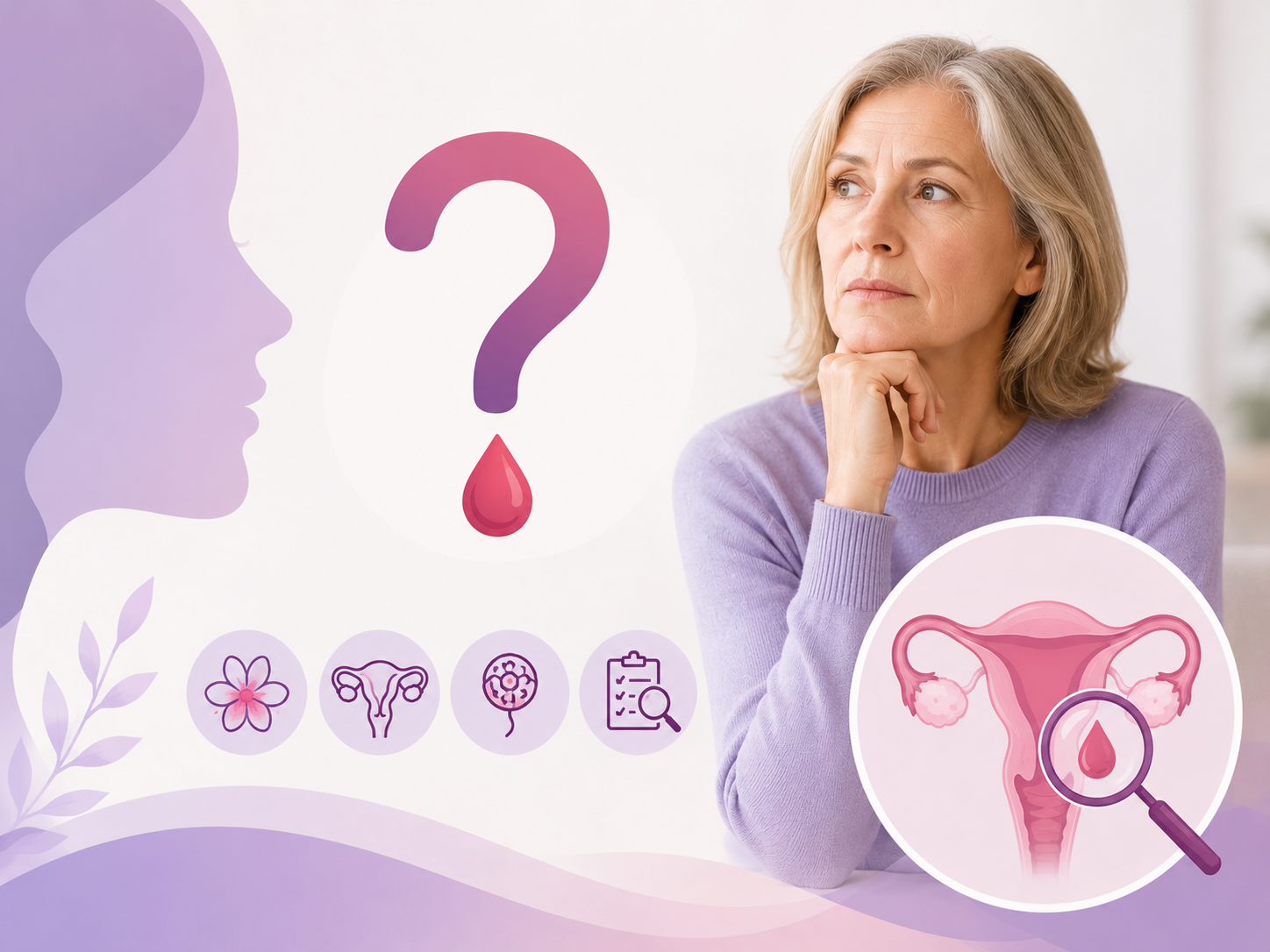
If you are asking why am I bleeding after menopause, it is important not to ignore it. Bleeding after menopause is not considered a normal part of menopause and should be checked by a healthcare professional. The cause can be something simple, such as vaginal dryness, but it can sometimes be linked to a condition that needs treatment.
Postmenopausal bleeding can happen for many reasons. Most causes are not cancer, but it is important to find out why the bleeding has happened.
What Counts as Bleeding After Menopause?
When is bleeding considered postmenopausal bleeding?
Menopause means you have gone 12 months without having a period.
If you then notice any bleeding, spotting, or pink or brown discharge, it should be checked.
The bleeding may be:
- A small spot of blood
- Pink discharge
- Brown discharge
- Light bleeding
- Bleeding similar to a period
- Bleeding that happens more than once
Even if it happens only once, tell your GP.
You should not assume that a small amount of blood is harmless simply because it stops on its own.
Is Bleeding After Menopause Normal?
Should I be worried about postmenopausal bleeding?
Postmenopausal bleeding is not something you should ignore.
However, try not to panic.
There are several possible causes, and many are not serious.
For example, vaginal tissues can become thinner and more sensitive after menopause. This can sometimes cause spotting.
Other causes include polyps, hormone treatment, infections, and changes in the lining of the womb.
In some women, bleeding can be an early sign of cancer.
This is why getting checked is important.
The purpose of an appointment is not to assume the worst. It is to find the cause.
What Causes Bleeding After Menopause?
There are several possible reasons.
Here are seven causes women should know about.
1. Vaginal Dryness and Thinner Vaginal Tissue
Can vaginal dryness cause bleeding after menopause?
Yes.
After menopause, lower oestrogen levels can make the vaginal tissues thinner, drier, and more sensitive.
This is sometimes called vaginal atrophy or genitourinary syndrome of menopause.
The tissues may become easier to irritate.
You may notice bleeding after:
- Sex
- A vaginal examination
- Using the toilet
- Physical activity
You may also have:
- Vaginal dryness
- Burning
- Itching
- Soreness
- Discomfort during sex
Although this is a common cause, you should still have unexplained bleeding checked.
2. Polyps
Can polyps cause bleeding after menopause?
Yes.
Polyps are small growths that can develop in the womb or cervix.
Most are not cancerous.
However, they can sometimes cause unexpected bleeding or spotting.
You may have no other symptoms.
A doctor may find a polyp during an examination or through an ultrasound or another test.
If a polyp is found, your doctor will explain whether it needs monitoring or removal.
3. Changes in the Womb Lining
Can the lining of the womb cause bleeding after menopause?
Yes.
The lining of the womb is called the endometrium.
After menopause, it normally becomes thinner because hormone levels fall.
Sometimes the lining can become thicker than expected.
This may happen for several reasons.
A thickened womb lining does not automatically mean cancer.
But it may need further investigation to understand why it has changed.
Your doctor may recommend an ultrasound to look at the womb and its lining.
4. Hormone Replacement Therapy
Can HRT cause bleeding after menopause?
Yes.
Hormone replacement therapy, commonly called HRT, can sometimes cause bleeding or spotting.
This can be more common when someone has recently started HRT or changed their treatment.
The type of HRT you use can also affect bleeding patterns.
However, new or unexpected bleeding should still be discussed with your doctor.
Do not stop prescribed HRT without speaking with your healthcare professional first.
Your doctor can check whether the bleeding is expected or whether another cause needs to be investigated.
5. Vaginal or Cervical Infection
Can an infection cause bleeding after menopause?
Yes, some infections or inflammation can cause spotting or bleeding.
You may also notice:
- Unusual discharge
- A change in smell
- Burning
- Itching
- Pelvic discomfort
- Pain when passing urine
Some infections are easy to treat once the correct cause is found.
If bleeding occurs with unusual discharge or pelvic pain, tell your doctor about all of your symptoms.
6. Fibroids or Other Gynaecological Conditions
Can fibroids cause bleeding after menopause?
Fibroids are non-cancerous growths that develop in or around the womb.
They are more common before menopause and often become smaller after menopause.
However, women who have had fibroids may still have symptoms.
Other gynaecological conditions can also cause bleeding.
Your doctor may need to look at the womb, cervix, vagina, and ovaries to understand what is happening.
This is why it is better to have postmenopausal bleeding investigated instead of trying to identify the cause yourself.
7. Cancer
Is bleeding after menopause a sign of cancer?
It can be, but it is important to remember that most women with postmenopausal bleeding do not have cancer.
However, bleeding can sometimes be an early warning sign of cancer of the womb or other parts of the reproductive system.
This is one of the main reasons doctors take postmenopausal bleeding seriously.
Finding a problem early can make treatment easier.
So, if you notice bleeding after menopause, arrange a medical assessment even if the bleeding is light or happens only once.
Can Bleeding After Menopause Be Caused by Sex?
Why do I bleed after sex following menopause?
Sex can sometimes cause spotting after menopause because vaginal tissues may become thinner and more sensitive.
Lower oestrogen levels can make the vagina drier.
Friction may then cause small areas of irritation or bleeding.
However, bleeding after sex can have other causes.
If it happens more than once, tell your GP or gynaecologist.
A simple examination can help identify where the bleeding is coming from.
What Does Brown Discharge After Menopause Mean?
Is brown discharge after menopause normal?
Brown discharge often means that a small amount of older blood has mixed with vaginal discharge.
It may look different from fresh red blood.
But brown discharge after menopause should still be discussed with a healthcare professional if it is new or unexplained.
The colour of the blood does not tell you exactly why it happened.
Your doctor may need to investigate the source of the bleeding.
Should I Worry About One Spot of Blood?
Is one episode of spotting after menopause serious?
Even one small episode should be checked.
You may only notice blood when wiping after using the toilet.
It may disappear within a day.
That does not mean you should ignore it.
The cause could be something minor, but your doctor needs to decide whether further tests are needed.
Do not wait for the bleeding to happen again before seeking advice.
When Should I See a Gynaecologist?
When should I get specialist help for postmenopausal bleeding?
Start by contacting your GP.
Depending on your symptoms and test results, you may be referred to a gynaecologist or a specialist clinic.
A specialist assessment may be needed if:
- Bleeding keeps coming back
- The cause is unclear
- Your womb lining looks thicker than expected
- A polyp is found
- An ultrasound shows an abnormality
- You have other pelvic symptoms
- Further tests are needed
Your doctor will decide what type of assessment is appropriate.
What Tests Are Done for Bleeding After Menopause?
How do doctors find the cause?
Your doctor will first ask about your bleeding.
You may be asked:
- When did the bleeding start?
- How much blood was there?
- Was it bright red, pink, or brown?
- Did it happen once or more than once?
- Did it happen after sex?
- Are you taking HRT?
- Are you using any medicines?
- Do you have pelvic pain?
- Have you noticed unusual discharge?
You may then have an examination.
Depending on your symptoms, you may need an ultrasound scan.
Can an Ultrasound Find the Cause?
What can an ultrasound show?
An ultrasound can help doctors look at the womb and its lining.
It may also help identify things such as fibroids or other changes.
A transvaginal ultrasound can provide a closer view of the reproductive organs.
If more investigation is needed, your doctor may recommend another test.
Will I Need a Biopsy?
Why would a doctor take a sample from the womb?
Sometimes a small sample of tissue from the womb lining is needed.
This is called an endometrial biopsy.
The sample is examined to look for abnormal cells or other changes.
Not every woman with postmenopausal bleeding will need a biopsy.
Your doctor will decide based on your symptoms, examination, ultrasound findings, and other risk factors.
What Happens If the Tests Are Normal?
Can postmenopausal bleeding stop without treatment?
Yes.
Sometimes the bleeding stops and no serious problem is found.
For example, the cause may be vaginal dryness or another non-serious condition.
Even when initial tests are reassuring, tell your doctor if the bleeding happens again.
Repeated bleeding may need another assessment.
How Is Postmenopausal Bleeding Treated?
Does the treatment depend on the cause?
Yes.
There is no single treatment for postmenopausal bleeding.
The treatment depends on what is causing it.
For example:
Vaginal dryness: Your doctor may recommend moisturisers, lubricants, or local hormone treatment when suitable.
Polyps: A polyp may sometimes be removed.
HRT-related bleeding: Your doctor may review your HRT and make changes if needed.
Infections: Treatment will depend on the infection causing the symptoms.
Thickened womb lining: Further tests may be needed before deciding on treatment.
Cancer: If cancer is found, you will be referred to the appropriate specialist team for treatment.
Can Postmenopausal Bleeding Be Prevented?
Is there a way to stop it from happening?
Not every cause can be prevented.
However, knowing what is normal for you can help you notice changes quickly.
Keep track of:
- Any vaginal bleeding
- Spotting
- Brown discharge
- Bleeding after sex
- Pelvic pain
- Changes in vaginal discharge
If something new happens, tell your doctor.
Early assessment is better than waiting and worrying.
Frequently Asked Questions
Why am I bleeding after menopause?
There are several possible causes, including vaginal dryness, thinner vaginal tissues, polyps, HRT, infections, fibroids, changes in the womb lining, and less commonly cancer. A healthcare professional should check unexplained bleeding.
Is bleeding after menopause normal?
No. Bleeding after menopause should be checked, even if it is only light spotting or happens once.
Can vaginal dryness cause bleeding after menopause?
Yes. Lower oestrogen levels can make vaginal tissues thinner and more fragile, which can sometimes cause spotting.
Can HRT cause bleeding after menopause?
Yes. HRT can sometimes cause bleeding, particularly when treatment is first started or changed. Unexpected bleeding should still be discussed with your doctor.
Can polyps cause bleeding after menopause?
Yes. Polyps in the womb or cervix can cause spotting or bleeding. Most polyps are not cancerous.
Can fibroids cause bleeding after menopause?
Fibroids can sometimes be linked with bleeding, although they often become smaller after menopause. Any new bleeding should still be investigated.
Is brown discharge after menopause normal?
Brown discharge can contain older blood, but new or unexplained brown discharge after menopause should still be checked.
Is bleeding after menopause a sign of cancer?
It can be, but most cases are caused by conditions other than cancer. Because cancer can sometimes cause early bleeding, it is important to have the symptom investigated.
Should I worry about one spot of blood after menopause?
One episode of spotting should still be reported to your GP. Even light bleeding can have several possible causes.
Can bleeding after sex be caused by menopause?
Yes. Vaginal dryness and thinner tissues after menopause can make bleeding after sex more likely. However, repeated bleeding after sex should be checked.
When should I see a gynaecologist for postmenopausal bleeding?
Speak with your GP first. You may be referred to a gynaecologist if the bleeding continues, returns, or requires further investigation.
What tests are done for bleeding after menopause?
Your doctor may perform an examination and arrange an ultrasound. Depending on the findings, you may need additional tests, such as a sample of the womb lining.
Can an ultrasound find the cause of postmenopausal bleeding?
An ultrasound can provide useful information about the womb, its lining, and other pelvic structures. Further tests may be needed to find the exact cause.
Does postmenopausal bleeding need treatment?
Treatment depends on the cause. Some women need treatment for vaginal dryness, polyps, infections, or other conditions, while others may need further investigation first.
Final Thoughts
If you have been asking “why am I bleeding after menopause?”, the most important thing is not to ignore the symptom.
Postmenopausal bleeding can have many causes.
It may be linked to something simple, such as vaginal dryness, or it may be caused by polyps, HRT, infections, changes in the womb lining, or another gynaecological condition.
In some cases, it can be an early sign of cancer.
That does not mean you should panic.
It means you should get checked.
If you notice fresh blood, spotting, pink discharge, or brown discharge after menopause, contact your GP.
Depending on the findings, you may need an ultrasound, further tests, or an appointment with a gynaecologist.
Medical Disclaimer
This article is for general educational purposes only. It does not replace a medical examination, diagnosis, or personalised medical advice. Any new vaginal bleeding after menopause should be discussed with a qualified healthcare professional.