
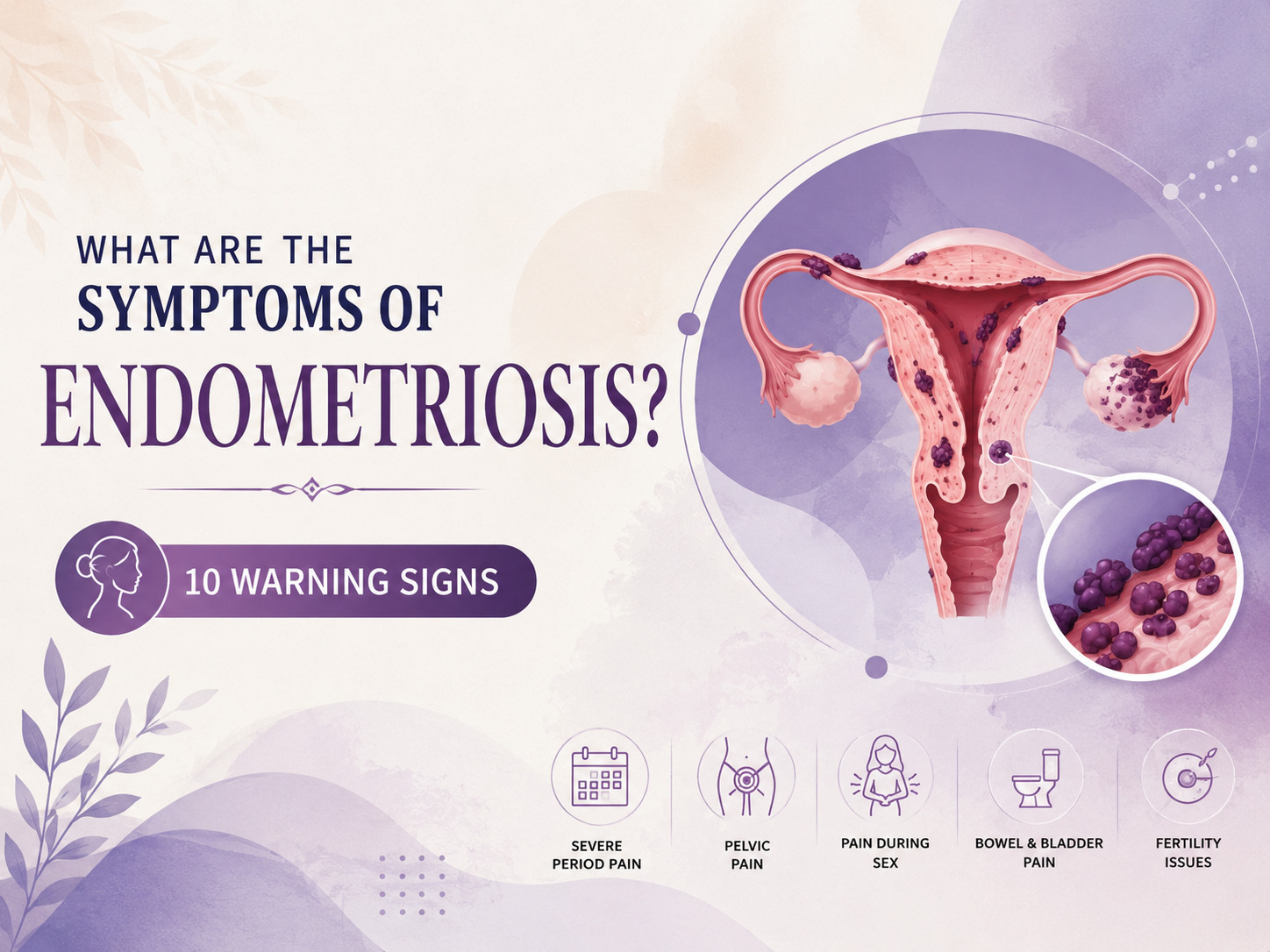
If you are asking what are the symptoms of endometriosis, the most common ones include severe period pain, pelvic pain, heavy periods, pain during sex, pain when using the toilet, bloating, tiredness and difficulty getting pregnant. Some women have only a few symptoms, while others have pain that affects work, sleep and everyday life.
Endometriosis is a long-term condition in which tissue similar to the lining of the womb grows outside the womb. It can affect areas such as the ovaries, fallopian tubes and the lining of the pelvis.
It is important to know that severe period pain is not something you always have to accept as normal. If your symptoms are affecting your life, it is worth getting them checked.
Could Your Period Pain Be More Than Just Period Pain?
Many women experience some pain during their periods.
But endometriosis pain can be much stronger.
You may notice that:
- Pain stops you from doing normal activities
- Painkillers do not give enough relief
- Your pain is getting worse over time
- You need to take time off work or school
- You feel exhausted during your period
- Pain continues after your period ends
If this sounds familiar, endometriosis may be one possible cause.
However, period pain can also be caused by conditions such as adenomyosis and fibroids. A healthcare professional can help find the reason.
What Are the Symptoms of Endometriosis?
There is no single symptom that proves you have endometriosis.
Instead, doctors look at the pattern of your symptoms.
Here are 10 signs worth knowing.
1. Severe Period Pain
Can endometriosis cause painful periods?
Yes. Severe period pain is one of the most common signs of endometriosis.
The pain may start before your period and become worse during bleeding.
It may feel like:
- Strong cramps
- Deep pelvic pain
- Sharp pain
- Throbbing pain
- Lower back pain
- Pain spreading into the legs
The key difference is often how much the pain affects your life.
If you regularly have to stop normal activities because of your period pain, speak with your GP.
2. Pelvic Pain Outside Your Period
Can endometriosis cause pelvic pain when I am not on my period?
Yes.
Although symptoms can become worse around your period, endometriosis can cause pelvic pain at other times too.
You may have pain that comes and goes throughout the month.
Some women describe it as a deep ache or pressure in the lower abdomen.
Others may have pain that becomes worse with exercise, bowel movements or sex.
Persistent pelvic pain should be investigated because there are several possible causes.
3. Heavy Periods
Can endometriosis cause heavy periods?
Yes. Some women with endometriosis have heavy menstrual bleeding.
You may notice that you:
- Need to change period protection very often
- Bleed through clothes or bedding
- Pass large blood clots
- Have periods that last longer than usual
- Feel very tired during your period
Heavy periods can also occur with fibroids, adenomyosis and other conditions.
So heavy bleeding alone does not confirm endometriosis.
4. Pain During or After Sex
Can endometriosis cause pain during sex?
Yes.
Some women with endometriosis experience deep pain during sex or discomfort that continues afterwards.
The pain may feel like pressure or a deep ache inside the pelvis.
This can affect relationships and may also make you feel anxious about intimacy.
Pain during sex should not simply be ignored.
There are many possible causes, including endometriosis, adenomyosis, fibroids, vaginal dryness and pelvic floor problems.
A medical assessment can help identify the cause.
5. Pain When Opening Your Bowels
Can endometriosis cause pain when I poo?
Yes.
Some women experience pain when opening their bowels, particularly around their period.
You may notice:
- Pain before or during a bowel movement
- Deep pelvic pain
- Constipation
- Diarrhoea
- Bloating
- A feeling of pressure
Bowel symptoms can sometimes be mistaken for IBS.
This is one reason endometriosis can take time to diagnose.
If bowel pain follows a clear pattern around your menstrual cycle, tell your doctor.
6. Pain When Passing Urine
Can endometriosis cause pain when I pee?
It can.
Endometriosis may sometimes affect areas close to the bladder.
You may notice pain when passing urine, particularly around your period.
Some women also experience other bladder symptoms.
However, painful urination is commonly caused by urinary infections and other bladder problems.
If you have burning when you pee, blood in your urine, fever or frequent urination, you should get medical advice.
7. Extreme Tiredness
Can endometriosis make you tired?
Yes. Many women with endometriosis report significant tiredness.
Living with ongoing pain can be exhausting.
Heavy periods may also contribute to iron deficiency and anaemia.
You may feel:
- Drained
- Weak
- Unable to concentrate
- Less able to exercise
- Sleepy even after resting
If tiredness is persistent, do not assume it is simply because you are busy.
Your doctor may want to look for anaemia or other possible causes.
8. Bloating and Digestive Problems
Can endometriosis cause bloating?
Yes.
Some women with endometriosis experience bloating, especially around their period.
You may feel that your stomach becomes:
- Swollen
- Tight
- Full
- Uncomfortable
Some women call this “endometriosis belly”.
You may also experience constipation or diarrhoea.
These symptoms can look similar to IBS.
One useful clue is whether your digestive symptoms follow a pattern with your menstrual cycle.
Keeping a symptom diary can help you spot this pattern.
9. Difficulty Getting Pregnant
Can endometriosis affect fertility?
Yes, endometriosis can be linked with fertility problems in some women.
However, having endometriosis does not mean that you cannot become pregnant.
Many women with the condition conceive naturally.
If you have been trying to become pregnant and also experience severe period pain or pelvic pain, tell your doctor.
A fertility assessment may help identify whether endometriosis or another condition could be affecting your fertility.
10. Back Pain
Can endometriosis cause back pain?
Yes.
Some women experience lower back pain with endometriosis.
It may become stronger before or during a period.
Back pain can also have many other causes, so it is important to consider your other symptoms.
If your back pain appears together with severe period pain, pelvic pain, bowel symptoms or pain during sex, mention all of these symptoms to your doctor.
What Does Endometriosis Pain Feel Like?
Is endometriosis pain always severe?
No.
Endometriosis affects women differently.
Some women have severe pain.
Others have mild symptoms or no obvious symptoms at all.
Pain may feel like:
- Strong period cramps
- A deep pelvic ache
- Sharp or stabbing pain
- Lower back pain
- Pain during bowel movements
- Pain during sex
- Pain when passing urine
The amount of pain does not always match how much endometriosis is present.
This is why symptoms should be taken seriously even if someone else tells you that your period pain is “normal”.
Is Endometriosis the Same as Adenomyosis?
What is the difference between endometriosis and adenomyosis?
They are different conditions, although their symptoms can look very similar.
With endometriosis, tissue similar to the womb lining grows outside the womb.
With adenomyosis, similar tissue grows into the muscle wall of the womb.
Both conditions can cause:
- Painful periods
- Pelvic pain
- Heavy bleeding
- Pain during sex
- Fertility problems
Your doctor may consider both conditions when investigating severe period pain.
Can Endometriosis Get Worse Over Time?
Does endometriosis always get worse?
Not necessarily.
Endometriosis affects each woman differently.
Some women have symptoms that remain fairly stable.
Others may experience symptoms that become more difficult to manage over time.
Pain can also change as the condition affects different areas of the pelvis.
This is why it is better to seek medical advice when symptoms are affecting your everyday life rather than waiting for them to become severe.
Is Endometriosis Dangerous?
Should I be worried if I have endometriosis?
Endometriosis is not cancer.
However, it can have a major effect on quality of life.
Ongoing pain can affect:
- Work
- Sleep
- Exercise
- Relationships
- Mental wellbeing
- Fertility
Some women also develop ovarian cysts or scar tissue related to endometriosis.
The aim of treatment is to control symptoms and help you live your normal life.
How Is Endometriosis Diagnosed?
What happens if I think I have endometriosis?
Your doctor will usually start by asking detailed questions about your symptoms.
You may be asked:
- When does your pain start?
- How long does it last?
- How heavy are your periods?
- Does pain happen during sex?
- Does it hurt when you poo or pee?
- Do your symptoms follow your menstrual cycle?
- Are you trying to become pregnant?
- Has anyone in your family had endometriosis?
You may also have a physical examination.
Depending on your symptoms, your doctor may recommend an ultrasound scan.
An MRI may sometimes be used when more detailed information is needed.
In some cases, a procedure called a laparoscopy may be used to look inside the pelvis.
Can an Ultrasound Detect Endometriosis?
Will a normal ultrasound rule out endometriosis?
Not always.
An ultrasound can be useful for finding some forms of endometriosis, including ovarian endometriomas, and can also help doctors look for other possible causes of pelvic pain.
However, endometriosis can sometimes be present even when an ultrasound does not show it.
This is why your symptoms and medical history remain important.
If symptoms continue, your doctor may recommend further assessment.
When Should I See a Gynaecologist?
When should I get help for possible endometriosis?
Speak with your GP if:
- Period pain is stopping your normal activities
- Your period pain is getting worse
- You have ongoing pelvic pain
- Sex has become painful
- You have pain when opening your bowels
- You have pain when passing urine
- Your periods are very heavy
- You are struggling to become pregnant
- Treatment has not improved your symptoms
Your GP may refer you to a gynaecologist if endometriosis is suspected or your symptoms continue.
Early assessment can help you understand what is causing your symptoms and what treatment options may be suitable.
How Is Endometriosis Treated?
Can endometriosis be treated?
Yes.
There is currently no single treatment that permanently removes endometriosis for everyone.
But treatment can help control symptoms.
Depending on your situation, your doctor may discuss:
- Pain relief
- Hormonal treatments
- Contraceptive medicines
- Hormone-based treatments
- Surgery
- Fertility treatment when needed
Your treatment should be based on your symptoms and personal goals.
For example, treatment can be different if you are trying to become pregnant compared with someone who is mainly looking for better pain control.
Can Endometriosis Be Treated Without Surgery?
Do I need surgery if I have endometriosis?
Not necessarily.
Many women start with medicines and symptom management.
Hormonal treatments can reduce or control symptoms for some women.
Surgery may be considered when symptoms are severe, medicines do not help enough, or endometriosis is affecting fertility or important organs.
A specialist can explain the benefits and possible risks before you make a decision.
Frequently Asked Questions
What are the symptoms of endometriosis?
Common symptoms include severe period pain, pelvic pain, heavy periods, pain during or after sex, pain when opening the bowels or passing urine, bloating, tiredness and difficulty becoming pregnant.
How do I know if I have endometriosis?
You cannot confirm endometriosis from symptoms alone. A doctor may review your symptoms, examine you and arrange scans or other tests.
What does endometriosis pain feel like?
It can feel like severe period cramps, deep pelvic pain, sharp pain, lower back pain or pain during sex, bowel movements or urination.
Can endometriosis cause bloating?
Yes. Some women experience significant bloating, particularly around their period.
Can endometriosis cause heavy periods?
Yes. Some women with endometriosis have heavy menstrual bleeding, although heavy periods can also have other causes.
Can endometriosis affect fertility?
It can affect fertility in some women, but many women with endometriosis can become pregnant naturally.
Can endometriosis cause back pain?
Yes. Lower back pain can occur with endometriosis, especially around menstruation.
Can endometriosis cause pain during sex?
Yes. Deep pain during or after sex is a recognised symptom.
Can endometriosis cause pain when I poo?
Yes. Some women experience pain during bowel movements, particularly around their period.
Can endometriosis cause pain when I pee?
It can, especially when endometriosis affects areas around the bladder.
Is endometriosis dangerous?
Endometriosis is not cancer, but it can cause long-term pain, fertility problems and other complications that may affect quality of life.
Can endometriosis go away on its own?
Symptoms often improve after menopause, but endometriosis is considered a long-term condition during the reproductive years. Treatment can help manage symptoms.
When should I see a gynaecologist for endometriosis?
Consider specialist assessment when pain is severe, symptoms affect daily life, treatment is not helping, or fertility is a concern.
How is endometriosis treated?
Treatment may include pain relief, hormonal treatment, other medicines and, in some cases, surgery. The best option depends on your symptoms and personal plans.
Final Thoughts
If you have been searching “what are the symptoms of endometriosis?”, look beyond period pain alone.
Severe periods, pelvic pain, heavy bleeding, painful sex, bowel or bladder pain, bloating, tiredness and fertility problems can all be important clues.
You do not need to have every symptom.
And severe pain should not simply be dismissed as something every woman has to live with.
If your symptoms are affecting your work, relationships, sleep or everyday activities, speak with your GP.
A proper assessment can help identify whether endometriosis or another condition may be responsible.
If endometriosis is diagnosed, there are several ways to manage it. The right approach depends on your symptoms, your health and whether you want to become pregnant.
Medical Disclaimer
This article is for general educational purposes only. It does not replace a medical examination, diagnosis or personalised treatment. If you have severe, persistent or worsening pain, very heavy bleeding, or symptoms that are affecting your daily life, speak with a qualified healthcare professional.